
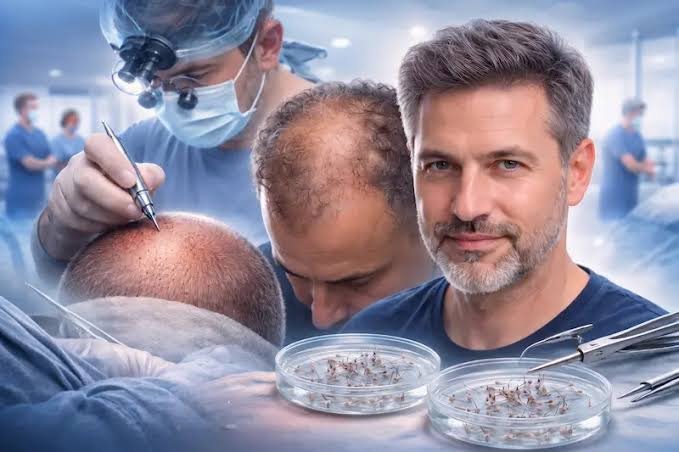
Follicular Unit Extraction (FUE) has evolved into the gold standard for surgical hair restoration. However, the ultimate success of an FUE procedure hinges entirely upon graft survival and minimizing the Follicular Transection Rate (FTR). Maintaining an FTR below 3% is the benchmark of surgical mastery, requiring an intimate understanding of scalp anatomy, punch physics, and tissue handling.
Core Surgical Principle
A transected follicle represents irreversible loss of donor resource. Unlike punch speed or extraction volume, follicular integrity cannot be compromised. Precision always supersedes operative pace.
1. Understanding the Subcutaneous Angle and Splay
The external exit angle of the hair shaft on the epidermis rarely reflects the true trajectory of the follicle beneath the dermis. In most donor regions, follicles exhibit a progressive subcutaneous curve, often diverging (splay) as they approach the bulb and dermal papilla.
Surgeons must execute continuous dynamic adjustments during extraction:
- Initial Engagement: Align the punch lumen concentric to the hair grouping at an acute angle matching the epidermal exit angle (typically 35° to 55° in the occipital scalp).
- Dermal Penetration: Score the epidermis and upper dermis to a depth of only 1.8mm to 2.2mm, releasing the rigid tethering of the arrector pili muscle.
- Sub-Dermal Elevation: Avoid deep mechanical coring into the subcutaneous fat; allow blunt dissection and gentle traction forces to deliver the bulb intact.
2. Punch Selection: Diameter, Sharpness & Motion Dynamics
Selecting the optimal punch requires balancing donor preservation with transection risk. An excessively narrow punch increases transection risk on multi-hair grafts, while an oversized punch creates visible hypopigmented scarring and slow wound healing.
| Punch Diameter | Primary Indication | Follicle Grouping | Recommended Movement |
|---|---|---|---|
| 0.80 mm – 0.85 mm | Temporal peaks, soft hairline singles | 1-hair follicular units | Oscillation (180° – 220°) |
| 0.85 mm – 0.90 mm | Occipital safe donor zone, standard density | 2 to 3-hair follicular units | Oscillation with micro-pause |
| 0.95 mm – 1.00 mm | Curly, afro-textured, or coarse beard grafts | 3 to 4-hair multi-units | Low-RPM continuous rotation |
3. Tumescent Anaesthesia and Tissue Turgor
Proper tumescent infiltration does more than deliver pain control and vasoconstriction; it establishes the hydraulic turgor necessary for stable punch engagement. Inadequate tumescence leads to skin elasticity collapse (troughing), forcing the punch off-axis and resulting in high transection rates.
Key tumescence recommendations during surgical extraction:
- Use buffered physiological saline containing lidocaine (0.5% to 1.0%) with 1:200,000 epinephrine and 8.4% sodium bicarbonate.
- Infiltrate immediately prior to scoring each quadrant to maintain uniform tissue firmness.
- Avoid excessive hyper-tumescence in scarred or fibrotic scalps, which can induce temporary tissue blanching and distorted follicle angles.
4. Out-of-Body Time & Hypothermic Holding Solutions
Extracted follicular units are vulnerable to ischemia-reperfusion injury, cellular dehydration, and metabolic exhaustion. Clinical studies demonstrate that graft survival drops measurably when out-of-body holding time exceeds 5 to 6 hours at room temperature.
Follicle Holding Best Practices:
- Temperature Control: Maintain grafts strictly between 2°C and 4°C using chilled storage plates throughout extraction and sorting.
- Holding Medium: Utilize intracellular-like holding solutions (such as HypoThermosol FRS or autologous PRP-enriched saline) rather than standard room-temperature saline for mega-sessions exceeding 3,000 grafts.
- Hydration Maintenance: Ensure surgical technicians continually mist sorting Petri dishes to prevent microscopic follicle desiccation.
5. Summary for Practicing Surgeons
Achieving superior follicular yield requires a disciplined, multi-step surgical protocol: meticulous pre-operative trichoscopy to map donor density, continuous microscopic audit of extracted bulbs, calibrated punch dynamics, and strict maintenance of the hypothermic chain. Mastering these fundamentals ensures predictable, high-density surgical outcomes and long-term donor preservation for every patient.