
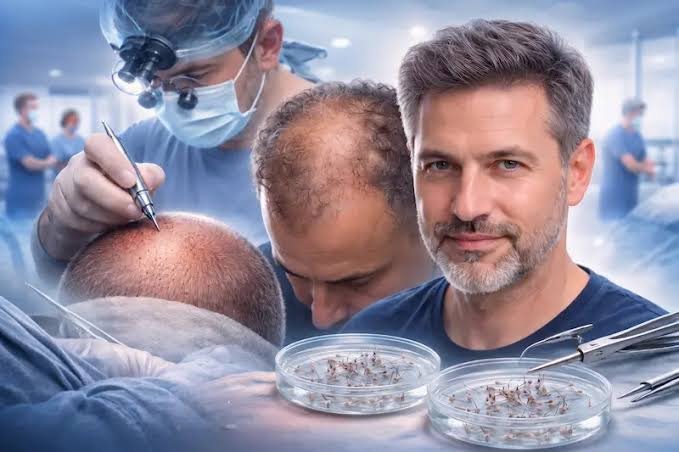
Hair restoration is becoming an increasingly relevant area of aesthetic and surgical medicine in Nigeria. As awareness of hair loss treatments grows and patients become more willing to seek procedural solutions, doctors are looking for ways to develop specialised skills in hair transplantation.
For Nigerian doctors, however, one challenge is particularly important: access to structured, hands-on hair transplant training close to home remains limited and fragmented. Hair transplantation requires much more than watching procedures or attending a theoretical seminar. Doctors need exposure to patient assessment, hairline design, donor management, follicular-unit extraction, graft handling, implantation, postoperative care and complication management.
This is creating an opportunity for international medical education and educational tourism.
Among the countries offering hair transplant training, India presents a particularly practical combination of clinical exposure, affordability, English-language education, established medical infrastructure and accessibility for African medical professionals.
For a Nigerian doctor considering specialised training abroad, India can therefore provide a pathway to acquire practical hair restoration skills without the cost structure associated with many Western destinations.
The Growing Need for Hair Restoration Expertise in Nigeria
Hair loss is not a marginal dermatological concern in Nigeria. Research conducted in Lagos has documented a high prevalence of hair loss in the population studied, with traction alopecia being particularly prominent. In one cross-sectional study of 307 participants at an urban Lagos market, 68.7% had hair loss; traction alopecia accounted for 71.7% of identified hair-loss types, while androgenetic alopecia accounted for 26.9%.
Another Nigerian study examining adult women in Lagos reported a prevalence of marginal traction alopecia of 76.3% among the study population.
These studies do not mean that every Nigerian patient is a candidate for transplantation. They do, however, demonstrate the scale and diversity of hair-loss conditions that Nigerian doctors encounter.
The clinical opportunity extends beyond traction alopecia. Androgenetic alopecia, scarring alopecia, post-traumatic hair loss and other forms of permanent hair loss can create demand for hair restoration services in appropriately selected patients.
As patients become more aware of FUE and other modern transplantation techniques, the need is not simply for more clinics. There is a need for appropriately trained doctors who can assess patients, determine candidacy, design procedures and perform surgery safely.
The Training Gap: Why Observation Alone Is Not Enough
Hair transplantation is a highly technique-dependent procedure.
A doctor can understand the theory of follicular-unit extraction relatively quickly. Developing the hand skills required to extract grafts without excessive transection, handle follicles correctly, create appropriate recipient sites and implant grafts with the desired direction and density requires supervised clinical practice.
The International Society of Hair Restoration Surgery (ISHRS) taskforce’s published hair-transplant practice guidelines specifically distinguish between observation and hands-on training. The guidelines state that physicians performing hair-transplant surgery need appropriate education, training and current competency. They recommend substantial supervised surgical exposure rather than relying solely on workshops or observation.
This distinction is important for Nigerian doctors.
A short conference may introduce FUE, DHI or FUT. An online course can explain the principles. A live demonstration can show the workflow. But none of these necessarily provides the tactile experience required to develop procedural competence.
Hands-on training should therefore be the central criterion when evaluating an international hair transplant course.
A good programme should ideally expose a doctor to:
- Patient consultation and candidate selection
- Scalp and donor-area assessment
- Hair-loss classification
- Hairline design and aesthetic planning
- Donor-area preparation
- FUE extraction techniques
- Graft handling and preservation
- Recipient-site creation
- Graft placement and implantation
- Postoperative protocols
- Infection control and surgical safety
- Recognition and management of complications
- Patient counselling and expectation management
- Different hair characteristics and clinical presentations
For doctors planning to establish or expand a hair-restoration practice in Nigeria, this practical exposure can be considerably more valuable than a certificate based primarily on classroom attendance.
Why International Training Is Becoming Relevant
Nigeria has a large medical workforce and established medical schools and teaching hospitals. The challenge is more specific: dedicated hair-transplant surgical training is not yet as widely established as general medical or postgraduate education.
Consequently, doctors interested in hair transplantation may have to search for individual workshops, private mentorships or overseas programmes.
This is where medical and educational tourism overlap.
Instead of travelling abroad as a patient, a doctor can travel abroad as a medical learner, spend several days or weeks inside a functioning hair-restoration environment and return home with structured practical exposure.
The model is already familiar to Nigerian professionals. India has been a destination for Nigerian students pursuing higher education since the 1950s. India’s Ministry of External Affairs notes that Indian institutions became popular among Nigerian students because of the combination of quality and cost-effectiveness, and that thousands of Nigerian students have been admitted through the Study in India programme.
This existing educational relationship reduces one of the psychological barriers associated with international training.
Why India Is Particularly Relevant for Nigerian Doctors
India’s strongest proposition is not simply that it offers hair transplant courses. Several factors combine to make India a practical training destination.
1. English is the common language of medical education
Language is an important consideration when choosing surgical training abroad.
Nigeria’s official language is English, while English is also extensively used as the language of medical education and professional communication in India.
This creates an obvious advantage.
A Nigerian doctor travelling to India does not need to learn a new language simply to understand lectures, communicate with trainers or study surgical protocols.
This is particularly important in hands-on education because communication has to be precise. Instructions regarding graft extraction, incision depth, angulation, implantation and patient safety cannot depend on translation.
2. India already has an international student ecosystem
Nigerian students are not new to India.
The Indian Ministry of External Affairs describes Nigeria as an established source of international students for Indian higher education and notes the availability of Indian government scholarship and Study in India pathways.
Historical Indian higher-education statistics have also placed Nigeria among the leading countries represented in India’s foreign-student population.
For a Nigerian doctor, this means that studying in India is not an unfamiliar educational pathway.
Accommodation, international student communities, travel routes, hospitals and educational institutions serving international learners are already part of the ecosystem.
3. The cost structure can be significantly more accessible
Affordability is one of India’s major advantages.
The cost of specialist medical education varies considerably by programme and provider, but Indian hair-transplant courses can be found at price points substantially below many Western private training programmes.
For example, currently advertised Indian programmes include a four-day hands-on FUT/FUE workshop priced at ₹1,00,000 plus GST, while another provider advertises a five-day advanced FUE/FUT hands-on programme at ₹80,000.
Longer programmes are also available. One Indian training provider advertises a 12-month FUE fellowship with direct clinical exposure, while another describes programmes ranging from seven-day certifications through three-month fellowships with progressively larger numbers of live cases.
The important point is not that every Indian course costs the same or that the cheapest course is necessarily appropriate. Rather, India provides a wide range of training formats and price points, allowing an international doctor to select training according to experience, budget and learning objectives.
India Compared With Other International Training Destinations
India is not the only destination available to Nigerian doctors.
Turkey
Turkey is arguably the most prominent international market for hair transplantation and offers significant exposure to high-volume procedures.
Its major advantage is clinical volume. Istanbul’s hair-restoration industry serves a very large international patient population, creating opportunities for intensive exposure. Current programmes advertise short courses involving live patients and hands-on FUE/DHI training.
However, the market is diverse, and the quality and structure of individual programmes can vary substantially. A Nigerian doctor should therefore evaluate the actual surgeon supervision, trainee-to-case ratio and number of procedures personally performed rather than choosing a programme solely because it is located in Turkey.
Turkey can be particularly attractive for doctors prioritising high procedural volume.
United Kingdom and Western Europe
The UK and Western European countries offer strong medical education systems and access to highly regulated healthcare environments.
However, specialist private surgical training can be comparatively expensive. Programmes may also be structured more around formal postgraduate education, observation, workshops or longer clinical pathways rather than short, high-volume international hands-on courses.
For a Nigerian doctor seeking a focused FUE training experience within a limited travel period, the cost and duration can become important considerations.
United States and Canada
North America offers sophisticated healthcare infrastructure and established academic and professional institutions.
However, the regulatory environment, travel costs, tuition structures and requirements for clinical participation can make these destinations less straightforward for an international doctor seeking short-term procedural training.
They may be appropriate for doctors pursuing longer academic or professional pathways, but are not necessarily the most practical option for a focused hair-transplant training trip.
Middle Eastern destinations
Countries such as the UAE offer modern healthcare infrastructure and a strong medical-tourism environment.
The challenge is cost. Training and living expenses can be considerably higher than comparable programmes in India, particularly when accommodation and travel are included.
India
India occupies an interesting middle ground.
It combines a large healthcare ecosystem with comparatively accessible costs, English-language education, international student familiarity and a growing number of specialised hair-restoration training programmes.
This makes it particularly relevant for doctors who want structured practical exposure without committing to the financial and regulatory burden associated with longer overseas education pathways.
A Cost-and-Access Comparison
| Destination | Main advantage | Potential consideration for Nigerian doctors |
|---|---|---|
| India | Affordable specialist training, English, broad healthcare ecosystem, international student familiarity | Quality varies by provider; course credentials and supervision must be verified |
| Turkey | Very high hair-transplant procedural volume | Programme quality varies; international medical-tourism environment can be commercially intensive |
| UK/Europe | Strong regulated medical education environment | Higher cost; potentially longer or less accessible clinical pathways |
| USA/Canada | Advanced medical infrastructure and academic opportunities | High cost and more complex access for short-term international clinical training |
| UAE/Middle East | Modern facilities and medical-tourism infrastructure | Generally higher training and living costs |
The comparison shows why India can be a particularly attractive value proposition, rather than simply another location on the global training map.
What Should Nigerian Doctors Look for in an Indian Training Programme?
Choosing India is only the first decision. Choosing the right training provider is arguably more important.
A Nigerian doctor should evaluate a programme against several criteria.
First, confirm that it is genuinely hands-on. Ask exactly what the trainee will personally perform rather than what the clinic will demonstrate.
Second, establish who provides supervision. The identity, qualifications and hair-restoration experience of the operating surgeon should be clear.
Third, ask about live-case exposure. The number of patients observed is less important than the number of procedures in which the trainee actually participates under supervision.
Fourth, examine the curriculum. It should cover the complete clinical pathway rather than extraction alone.
Fifth, understand eligibility requirements. Hair transplantation is a surgical procedure, and programmes should have clear criteria regarding medical qualifications and permitted clinical activities.
Sixth, examine post-course support. Mentorship after returning to Nigeria can be particularly valuable for doctors performing their first independent cases.
Most importantly, doctors should not equate a certificate with competence. A certificate documents completion of a programme; competence comes from education, supervised practice, repetition, feedback and continuing professional development.
The Educational Tourism Opportunity
For Nigerian doctors, travelling to India for hair transplant training can therefore be viewed as more than a short course.
It can form part of a broader medical educational tourism pathway.
A doctor could combine structured hair-transplant education with exposure to India’s hospitals, aesthetic medicine practices, dermatology clinics and healthcare technology ecosystem.
The same trip can also provide opportunities to interact with other international doctors and develop professional relationships that continue after returning to Nigeria.
This is particularly relevant as Nigerian doctors increasingly explore aesthetic medicine and private-practice opportunities.
The objective is not simply to bring a foreign technique back to Nigeria. It is to develop a doctor who understands patient selection, surgical planning, technique, safety and long-term hair restoration outcomes and can apply that knowledge within the Nigerian clinical environment.
Why India Can Make Sense for a Nigerian Hair Transplant Doctor
When the major factors are considered together, India’s proposition becomes clear.
Nigeria has a substantial and diverse hair-loss burden, while specialised hair-transplant training opportunities remain comparatively limited. Nigerian doctors therefore have a reason to look beyond domestic education.
International options exist, but each comes with different combinations of cost, accessibility, language, training duration, procedural volume and regulatory complexity.
India offers a combination that is particularly relevant to Nigerian professionals:
- English-language medical education
- Established Nigerian student presence
- Longstanding India–Nigeria educational links
- Comparatively affordable training
- Multiple course durations and formats
- Access to live surgical cases
- Large and diverse medical ecosystem
- Established private healthcare and aesthetic medicine sectors
- International exposure without the cost structure of many Western destinations
India should not be viewed as automatically superior simply because it is affordable. The quality of the individual faculty, clinical environment, supervision and hands-on exposure remains decisive.
But when the objective is to obtain practical hair-transplant training in an English-speaking, medically established and comparatively cost-effective international environment, India offers a compelling combination of factors for Nigerian doctors.
For a qualified Nigerian doctor looking to add hair restoration to an existing dermatology, aesthetic medicine or surgical practice, hands-on training in India can provide a practical bridge between theoretical knowledge and real-world clinical capability.
The ultimate value of the trip is not the certificate or the destination. It is the supervised surgical experience, clinical judgement and technical foundation that the doctor brings back home to serve patients in Nigeria.